
New to Running? Try These Three Ways to Get Faster

 This article is by Ben Delaney, NYRR’s Head of Training Programs and Education.
One of the first questions most new runners ask is, “How do I get faster?”
You may be surprised to learn that the answer isn't, "Just run fast—all the time!” In fact, that may be the worst way to try to increase your running pace because it can lead to injury.
Instead, try these three ways to work on your speed safely and effectively.
#1: Vary Your Pace
Not every run you do should be at the same pace. Instead, approach your running as a series of ups (faster/harder efforts) and downs (slower/easier efforts). Varying your running pace in this way allows your body to adapt to new stresses, and then recover from them.
As you look to alternate faster and slower runs, a great tool is the "talk test." As you run, try to talk. If you find yourself able to talk easily on every run, consider increasing your effort on some of your runs, to the point where you can no longer talk easily. You shouldn't be completely breathless, but you shouldn't be able to chat without a bit of strain.
Pushing yourself in this way will help your body to adapt to a slightly harder effort. Over time, this will make you faster.
Don't always run at a pace where talking is difficult. Instead, on some runs, back off the pace so you can talk for the entire run. These easier runs will allow your body to recover and adapt to the new stresses. Without them, you'll start to feel tired all the time and you'll risk an injury.
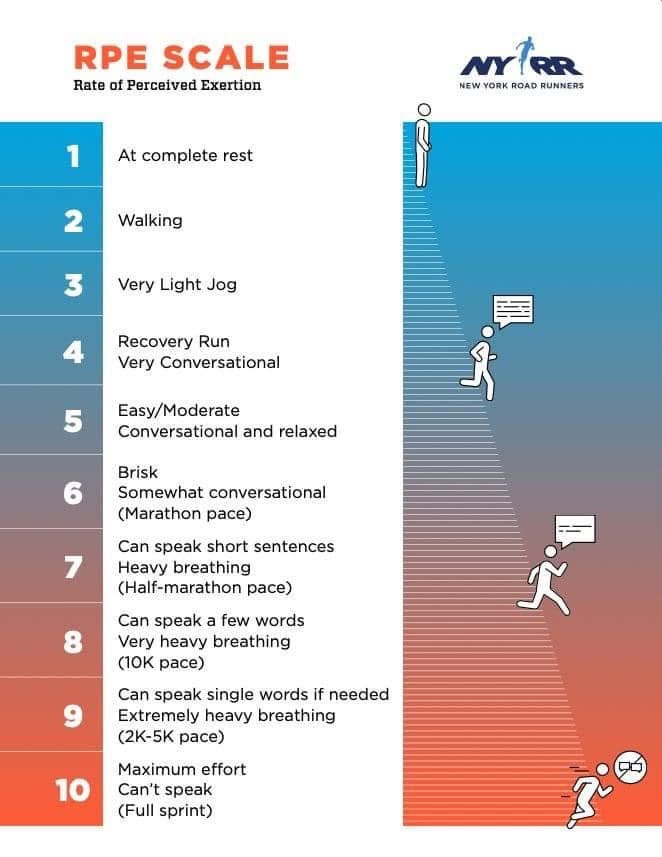
The Rate of Perceived Exertion (RPE) scale above shows the range from complete rest to maximum. In New York Road Runners Group Training, runners train based on RPE.
#2: Add a Workout
As you become more comfortable with your fitness, consider adding a workout once a week or so. Workouts introduce new stresses that continue to promote muscle adaptations and increased aerobic fitness.
A workout should not involve going all out, all the time. Instead, it should have a focused hard effort usually combining faster running with periods of rest.
Here's a sample workout that takes only 20 minutes:
- Start with a 5-minute easy jog (you can talk easily) to warm up.
- Follow with 10 minutes of varied pace work, such as 30-second surges (you can't talk easily) alternating with 90 seconds of easy running (can talk); repeated five times.
- Finish with another 5-minute easy jog to cool down.
If you prefer, you can do the varied pace work by running distances, such as laps around a track, or using landmarks, such as light poles. For example, surge for 2 light poles, then run easy for 3 light poles, and so on.
#3: Improve Your Running Economy
The more efficiently we use oxygen while running, the better our running economy, meaning that we use less energy to maintain a certain pace. Over time, and we can achieve a faster pace with similar oxygen use. Running economically leads to better performance—you can run faster and/or farther—because you’re using oxygen efficiently for sustained efforts over long(er) durations
Here are few ways you can improve your running economy:
- Consistent training. This doesn’t mean running every day. Training should include regular/easy runs, speed training, and rest days (no running).
- Targeted training. Incorporating varied paces, goal-specific paces, and hills will enhance running economy.
- Running form. The key to good form is focusing on running mechanics, with a slight forward lean from the ankles, a stride that falls beneath (not in front of) the body, and arms swining at your sides, not across your torso.
Follow the three steps outlined here, listen to your body, and you'll soon find yourself running faster—all while staying healthy and enjoying the journey.
You May Also Like...
How to Fit Running Into Your Busy Schedule