
What It Means to Keep Moving: From One Step to Four Miles
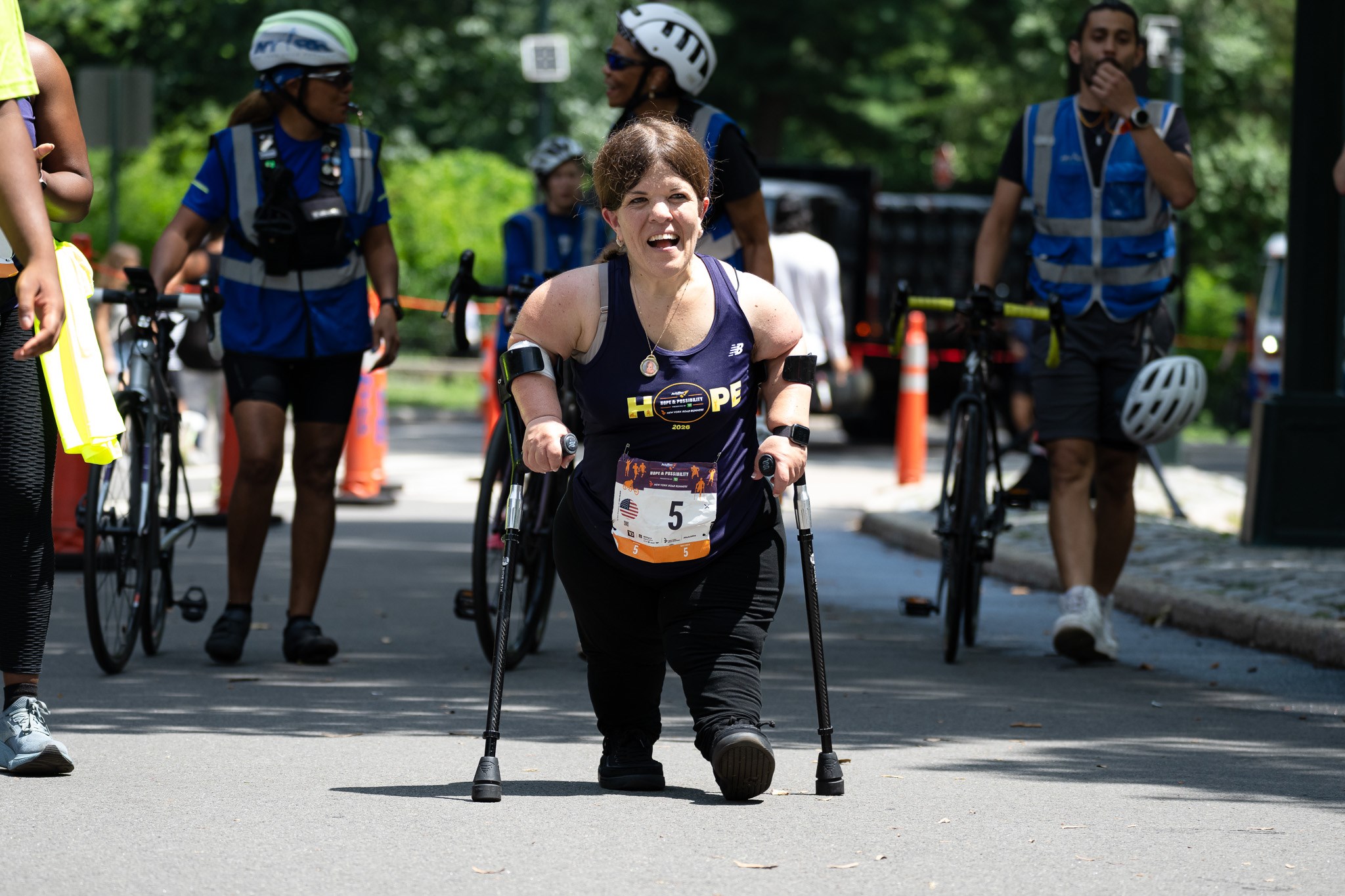
Becky Jackson Curran at the Achilles Hope & Possibility 4M Presented by TD.
Becky Jackson Curran (she/her) is a disability inclusion advocate, speaker, and athlete who has delivered more than 650 presentations worldwide on leadership, accessibility, belonging, and disability inclusion. Becky is the newest member of the NYRR Contributors Circle and shares her experience growing up playing sports and how she went from one step to four miles.
I was never sure the word runner belonged to me.
For most of my life, I measured movement differently. Because I am someone with dwarfism, my body has always come with limitations others do not have to think about. Nine surgeries reinforced that reality. There were seasons when success meant healing, not competing. Simply showing up to complete daily tasks often required more effort than anyone could see. Every commitment carried challenges behind the scenes. That’s why I take pride in being someone who follows through. I went from being confined to my bed during my most recent recovery to taking my first steps again. Then I started walking. First, a few feet. Then a few yards. Little by little, those hard-earned steps became miles. Every bit of progress felt impossible until it wasn't.
When I say I’m going to do something or show up, I do—no matter what it takes to get there.
Sports as Connection
I’ve loved sports since childhood, and even during and after my surgeries, I never stopped seeing myself as an athlete.
Sports were about connection and belonging, about finding my place even when my body required a different pace. Movement has always shaped how I understand myself.
I grew up playing soccer, sailing, skiing, and swimming alongside my average-height peers. In high school, after temporarily losing my ability to walk and undergoing spinal laminectomy, I worked hard in physical therapy to regain my mobility and returned to youth soccer while joining the high school swim and sailing teams.
I earned the Presidential Physical Fitness Test award on the sit and reach test. Moments like that challenged assumptions about what athleticism looks like and reinforced my belief that there is no single way to be an athlete.
After college, my best friend, Joanna, and I completed multiple 5Ks together. We were never focused on our times or when we finished. We were focused on showing up for each other.
At 31, I walked nearly 12 miles across New York City with my dad, crossing both the George Washington Bridge and the Brooklyn Bridge. Every step reinforced something I had always known deep down: I was an athlete, and my body was capable of more than others often assumed.
Forever Changed
At 37, I gave birth to my son, Jackson, who entered the world and forever changed my heart. At a young age, he was already an athlete, proudly mastering tummy time and building strength one small movement at a time. I loved watching him discover what his little body could do. Six months and 21 days later, he died in my arms. In the midst of unimaginable grief, I felt a responsibility to carry his legacy forward and ensure his life continued to make a difference.
During the summer after Jackson died, I kept moving, reaching more than 100 days of 10,000 steps, one step at a time.
Then, at 39 and a half, everything changed.
On August 1, 2023, I underwent a 10-hour spinal fusion surgery and was diagnosed with an incomplete spinal cord injury. Suddenly, I faced a question I had never wanted to ask: What if I never walk again?
Walking made me feel fragile. Things I once took for granted suddenly felt out of reach. There were days when I wondered what my future would hold and whether I would ever feel like myself again.
But I kept moving forward.
About a year later, I wheeled into my surgeon’s office, exhausted from standing for six minutes. She said, “I want to see you out of that wheelchair. I can picture you doing a 5K someday.”
At the time, that felt like an impossible goal. Still, something inside me responded. Challenge accepted.
Recovery became my main focus. Physical therapy, boxing, repetition. Progress was not linear, but slowly my body relearned what it once knew.
Every step mattered.
On April 27, 2025, I stood at the starting line of the Bionic Project 1-mile race in Cambridge, Massachusetts. I did not know what my body would give me, so I focused on one thing: Keep moving.
When I crossed the finish line in 1:33:21, I was embraced by one of the physicians who had cared for me during my seven weeks at Spaulding Rehabilitation Hospital.
It was not just a mile. It was reclaiming a future I once feared I had lost.
Months later, I completed the New Balance 5th Avenue Mile in the rain. I crossed the finish line soaked but smiling. I began to see myself differently.
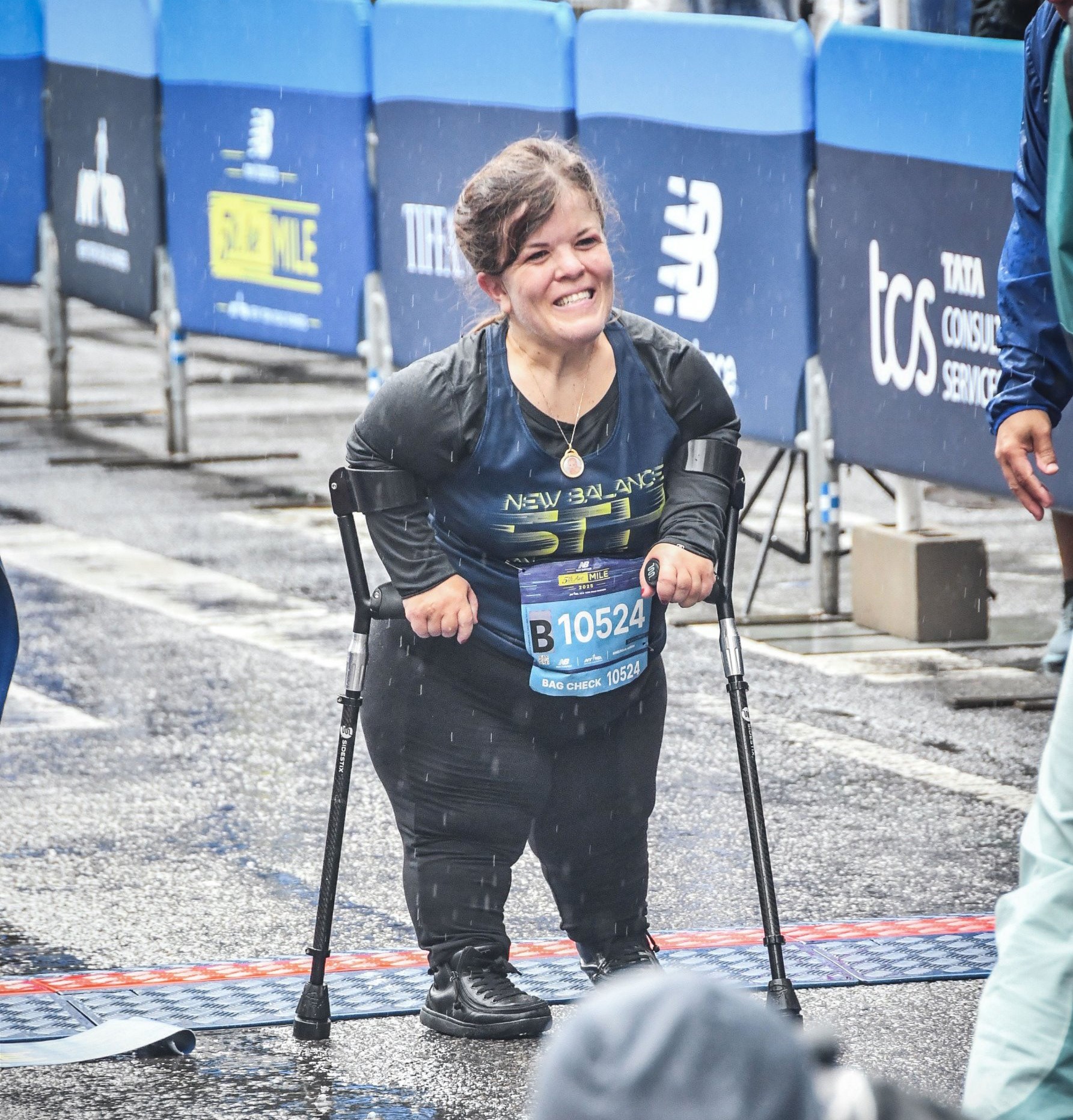
Becky crossing the finish line at the New Balance 5th Avenue Mile.
For years, I hesitated to call myself a runner. New York Road Runners gave me a message I needed: If you show up, you belong. You are a runner. I am a runner.
On November 9, 2025, 492 days after my surgeon first planted the idea, I completed a Bionic Project 5K in San Francisco in 3:47.
I had proof.
Chosen Family
Then came Achilles International.
In March 2026, I joined a community that supports athletes with disabilities through training and connection. What I found was more than a running group. I found a chosen family.
Every week, I train alongside guides who adjust their pace to match mine. Many are accomplished runners, yet every Tuesday, they choose to walk beside me. Their role extends far beyond encouragement. On race days, my guides help me navigate crowded sections of the course, reach hydration stations, avoid obstacles, and recover after any falls. Their presence is not just reassuring. It makes participation possible.
It taught me something powerful: Belonging is not just inviting someone in; it is meeting people where they are.
On June 28, 2026, I arrived in Central Park for the Achilles Hope & Possibility 4M Presented by TD.
The energy I felt was immediate. Richard Whitehead, a double Paralympic gold medalist and the fastest leg-amputee marathon runner in history, could have focused solely on his own race. Instead, he took the time to encourage me and make sure I felt ready. In that moment, I learned that belonging isn't about keeping pace with everyone else. It's about being welcomed, supported, and valued exactly where you are.
Throughout the race, strangers called out, “Go, Achilles!” reminding me I was part of something bigger.
The miles were hard. I fell at mile 3, but I got back up and kept going. Step by step, I pushed forward. When I reached the 5K mark, I realized I had done it almost 50 minutes faster than my 5K in November. In that moment, I saw tangible proof of the progress I had worked so hard to achieve.
Eventually, I became the final finisher. Years ago, that might have embarrassed me. This time, I felt only gratitude. There was a time when I could not stand for six minutes, let alone complete four miles. Finishing last did not diminish the accomplishment. It made it even more meaningful.
The crowd, volunteers, and guides all stayed. Achilles CEO Emily Glasser walked the final mile with me and placed my medal around my neck at the finish line. It was a powerful reminder that true inclusion isn't about finishing first. It's about ensuring everyone has the opportunity to cross the finish line.
As my favorite song, “Don’t Stop Believin,’” played, I realized those four miles were never about speed. They were about the courage to keep going long after it would have been easier to stop, to believe in a future I couldn't always see and to take the next step anyway.
That moment captured everything. True inclusion is creating a space where everyone feels they belong and can contribute to something greater than themselves.
Those four miles represented years of recovery, moments of doubt, and countless decisions to keep going when giving up would have been easier. Crossing that finish line was more than completing a race. It was proof of how far I’ve come, and a reminder that this is only the beginning.
From one step to one mile and from one mile to four, this journey was never about speed. It was about belief: belief that progress is possible, that small steps matter, and that showing up counts.
Because the distance between impossible and possible is often just the courage to take the next step.
You May Also Like...