
Celebrating Lunar New Year as a Declaration of Belonging
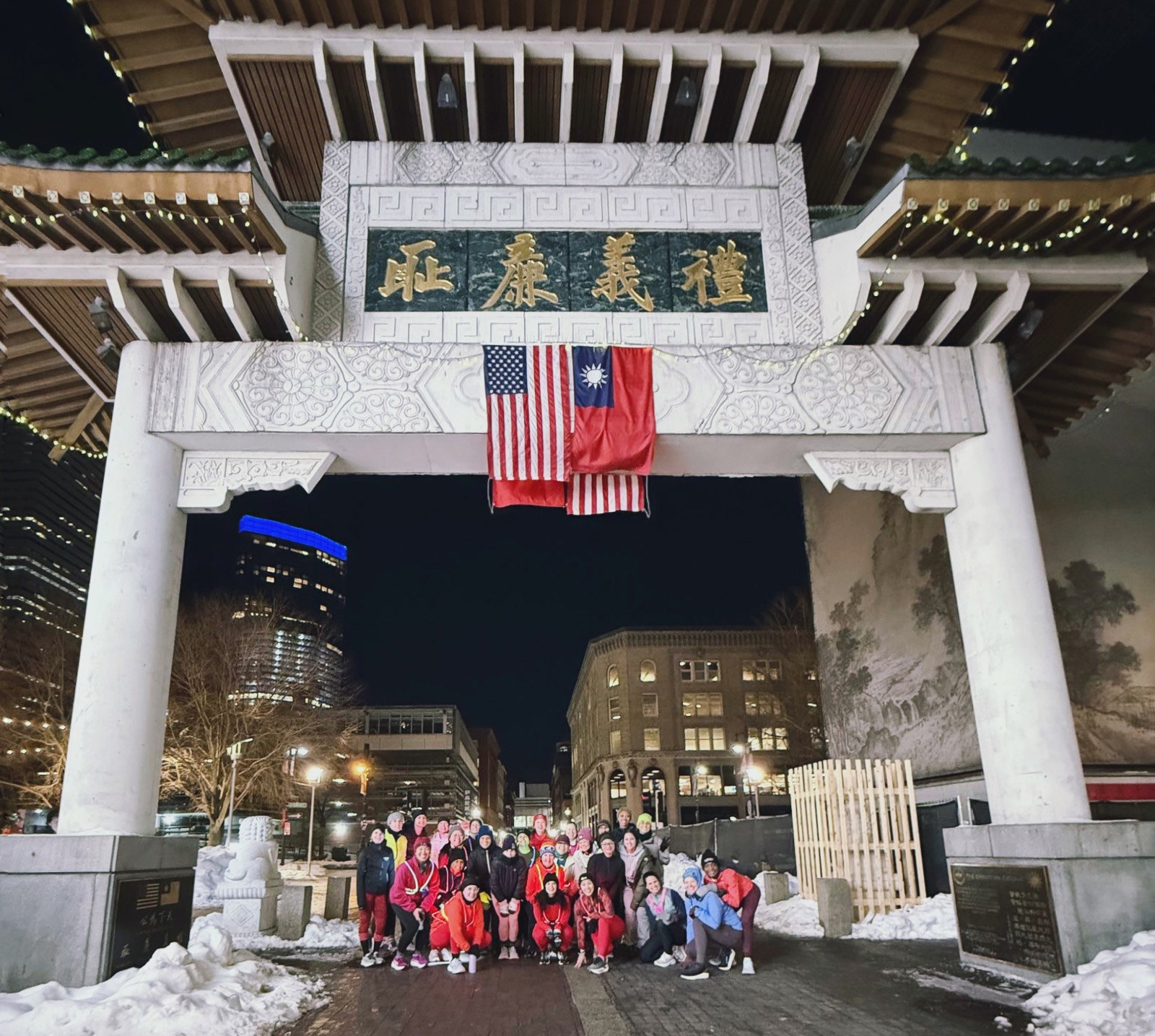
Food run tour group in front of the Chinatown gate with the words, “Propriety, Justice, Integrity, and Honor” inscribed.
Carolyn Su, the founder of the Diverse We Run platform, shares her experience leading a food run tour through Boston's Chinatown in this NYRR Contributors Circle blog post.
I can count on one hand the number of times my parents have ever said the words, “I love you,” to either me or my younger sister. Instead, “Have you eaten yet?” or something of that variation, was their way of communicating love. Whenever I visit, their fridge is stocked with my favorite seltzers and snacks; our plans are made around where and what we will eat, and whenever it is finally time to leave, my mom will undoubtedly hand me an upcycled brown, crinkly, paper bag filled with small baggies of cleaned, peeled fresh fruits neatly cut into easy-to-eat pieces.
Food has always been the love language of my relatives and of my community. Not only that, but sharing meals is the ultimate act of communicating acceptance and belonging.
That is why it was so special for me to be able to create, lead, and host a food run tour through Boston’s Chinatown this year in celebration of the Lunar New Year. I wanted to lead folks on a 3-mile run while highlighting the history of the first Chinese immigrants in the country and in New England. We would finish the run tour with delicious, freshly baked goods from a long-standing Chinatown institution: Ho Yuen Bakery.
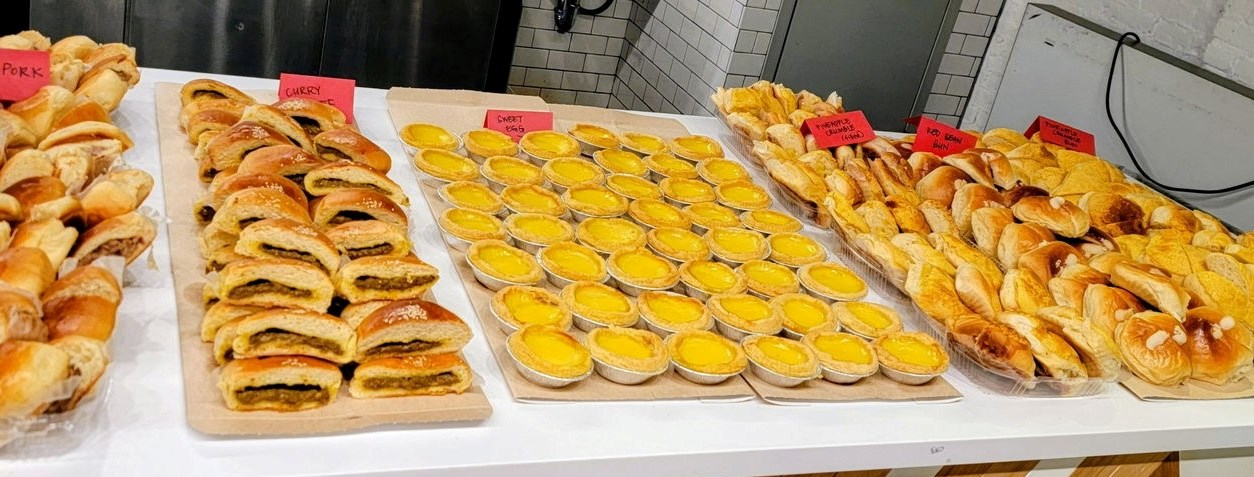
Assortment of sweet and savory baked goods from Chinatown’s renowned Ho Yuen Bakery.
While Lunar New Year is typically a time of celebrating renewal and setting intentions for the year ahead, mobilizing to bring together the local running community, this year, felt particularly poignant and necessary, especially in light of the broader dialogue of hostility against immigrants by those claiming to define our national identity.
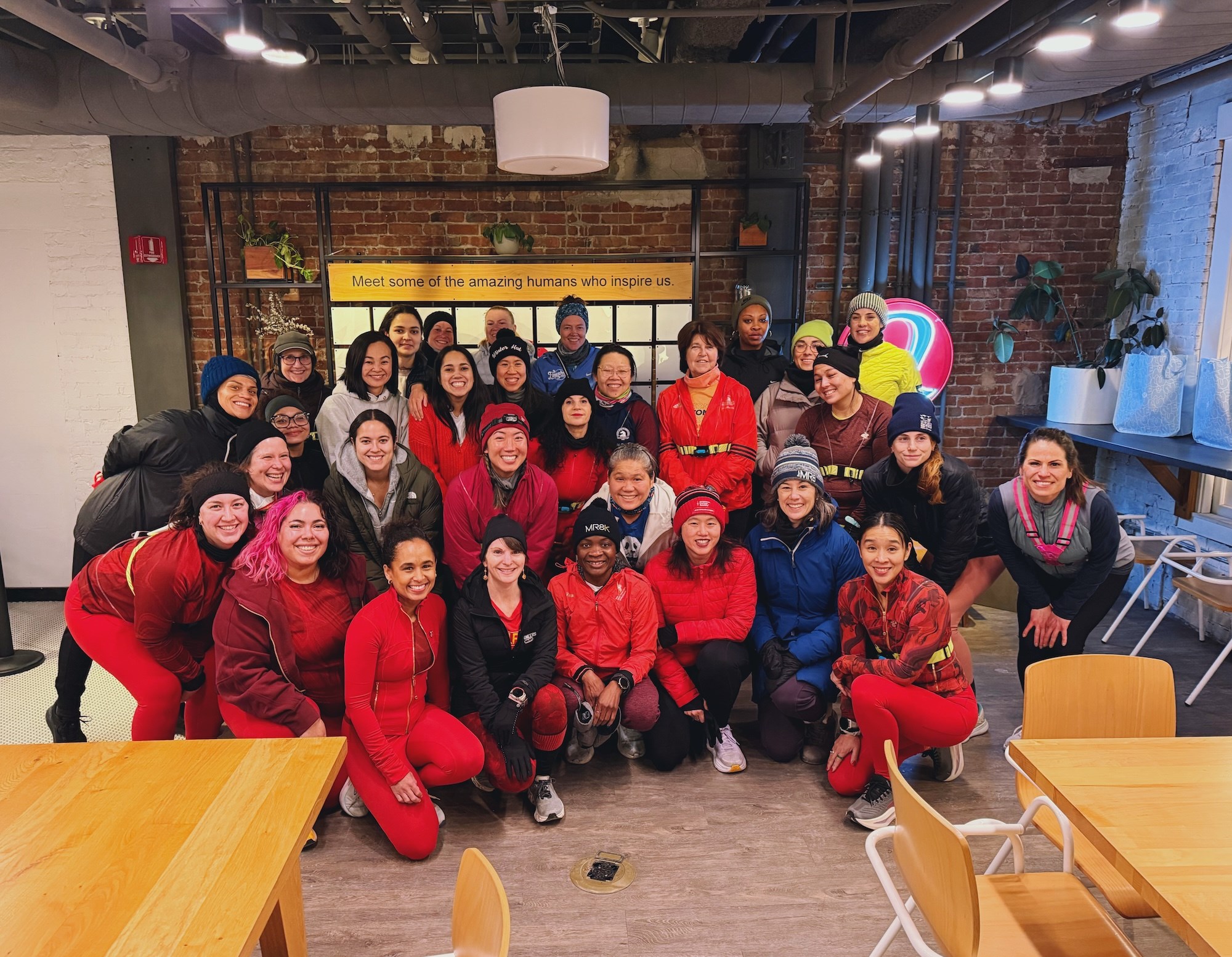
Together with the TrailBlazHers Run Co., ready to run through Chinatown.
Just like sharing a meal together, the act of running together opens a space of vulnerability that allows for people to connect on a personal level and to find common ground.
What if we created a way to combine running with culture?
What if, in revisiting Chinese American history, we see that our histories are all interconnected—that an immigrant’s story is America’s story?
From Back Bay to South Cove
On an icy and windy 20-degree evening, our group of 30 women gathered and started the food run tour out of the community space at lululemon on Newbury Street, the heart of Boston’s premier shopping district (shout out to lululemon for providing our meetup space!). As the streets transitioned from the shiny cobblestones of Back Bay to the crumbling, cracked concrete around Chinatown, the noise level of traffic from I-90 also grew noticeably louder. Sidewalks got narrower and more uneven, as we wove through the South End before making our way over the highway overpass and catching our first glimpses of Chinese symbols in neon marquees, glowing brightly in the darkening evening.
“Why did we go through the South End?” someone asked.
“Good question,” I said.
While Boston’s Chinatown is the third largest Chinatown in the country, it houses an increasingly smaller percentage of Chinese Americans than before, because of urban renewal, highway construction, and institutional expansion. Originally a landfill of the South Cove, Chinatown spanned a much larger area, up to Downtown Crossing and into the South End; but as developers continued to raze residential buildings and businesses were forced to close, thousands of citizens were displaced further out into the greater-Boston area. Eventually, when the Tufts Medical Center was built in the late 1980s, it further demolished the remnants of community life, leaving what is now essentially a 3x3 block area of present-day Chinatown.
“What does it mean when some neighborhoods like the Back Bay are designed to be preserved, while others must fight to remain?” I asked the group, and the question hung in the air.
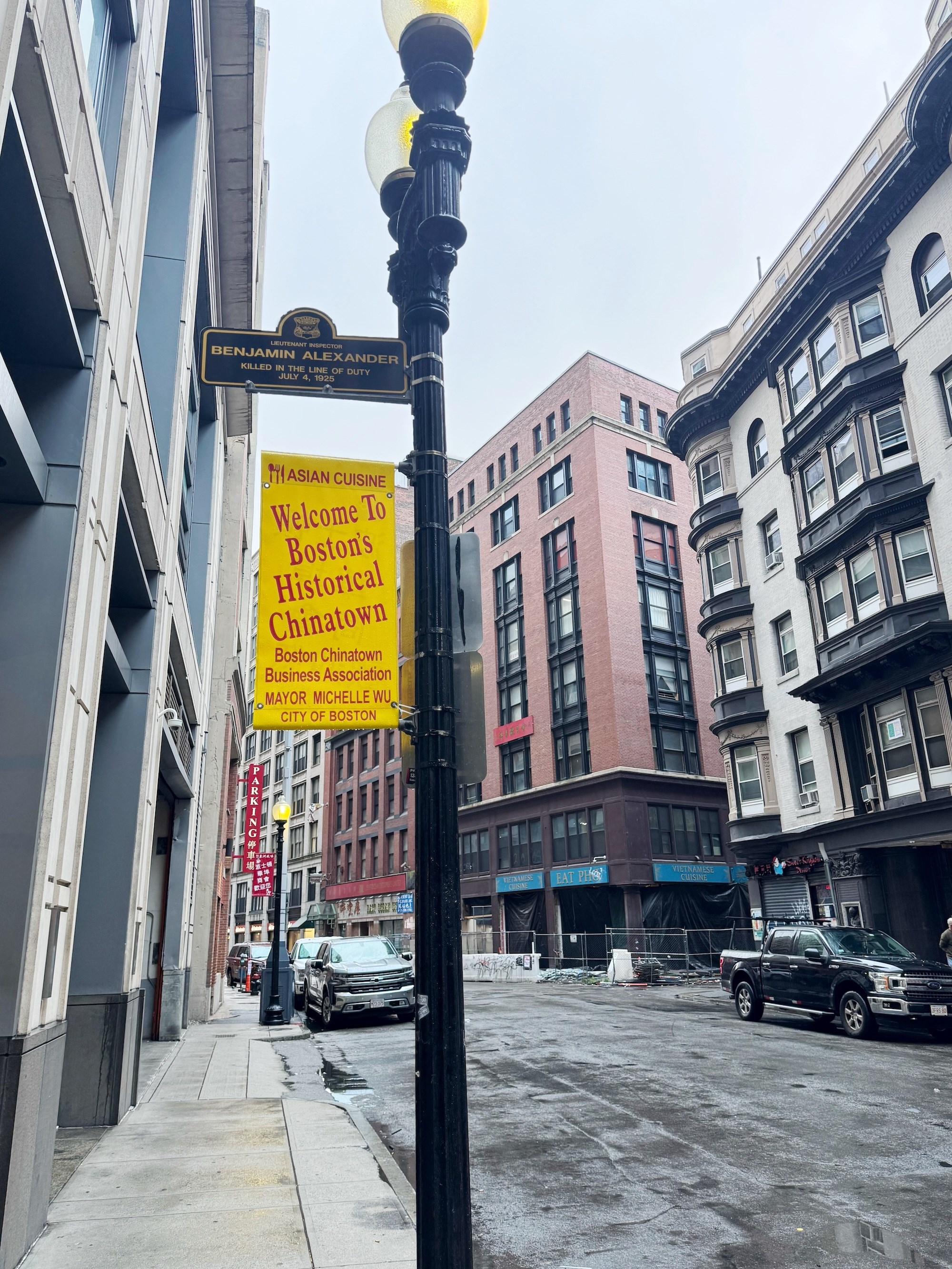
At the corner of Beach St. and Washington St. in Chinatown.
One block over, we stopped in front of the Boston Chinatown Neighborhood Center (BCNC). A mural of a jade-colored path, dotted with children playing, wraps around the windows of the ground floor of the building. The painted path converges at a golden tree, with its roots extending beyond the mural and its branches reaching up into the heavens. BCNC is the largest social service provider to Asian families in the greater Boston area, and it also serves as a community center and hub for various cultural programs for all ages (the previous YMCA having been demolished to build the Tufts Medical Center).
As homes and community gathering spaces were continuously destroyed, grassroots and civic institutions, such as the BCNC and the Chinatown Community Land Trust, were established to advocate for the community members, with services ranging from medical care, to the restoration of public libraries, to the preservation of affordable housing.
On the building opposite the BCNC, a holographic art installment hangs on the brick wall, featuring the faces of Chinese workers and immigrants from past to present. Above it, a banner flaps in the wind, reading, “Chinatown is our home. We are here to stay.”
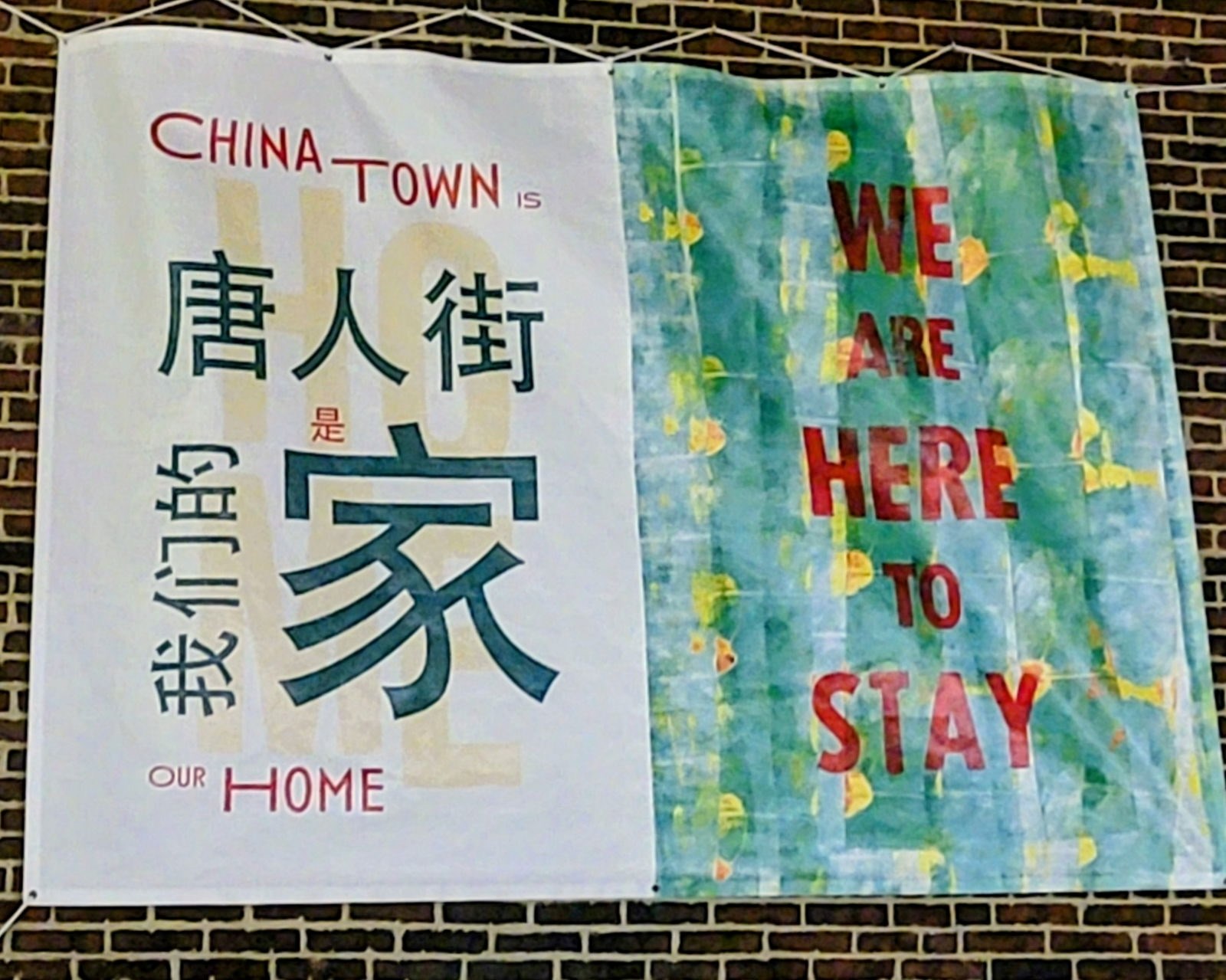
Banner above the art installation, “Immigrant History Trail,” at Oak Place and Maple St, outside of BCNC.
Where We Came From
As we ran further into the heart of Chinatown, the streets were illuminated by signage from restaurants, bakeries, and boba shops. This is the image that is most conjured up, when one thinks about Chinatown, but what is not as well known is that all the current businesses are housed in buildings that were formerly Chinese laundries.
Early residents of Chinatown worked primarily in small, family-owned laundries, mainly because it was menial work that no one else wanted to do, and also because anti-Chinese discriminatory laws restricted other forms of employment.
In Boston, there were over 250 laundries within the borders of Chinatown, and they served clientele from the Back Bay to the greater New England area. Families lived in the apartments above the laundries, and they hand washed all the clothes and linens brought in. The last remaining laundry building in Chinatown currently houses a sushi restaurant on the corner of Harrison and Beach Street.
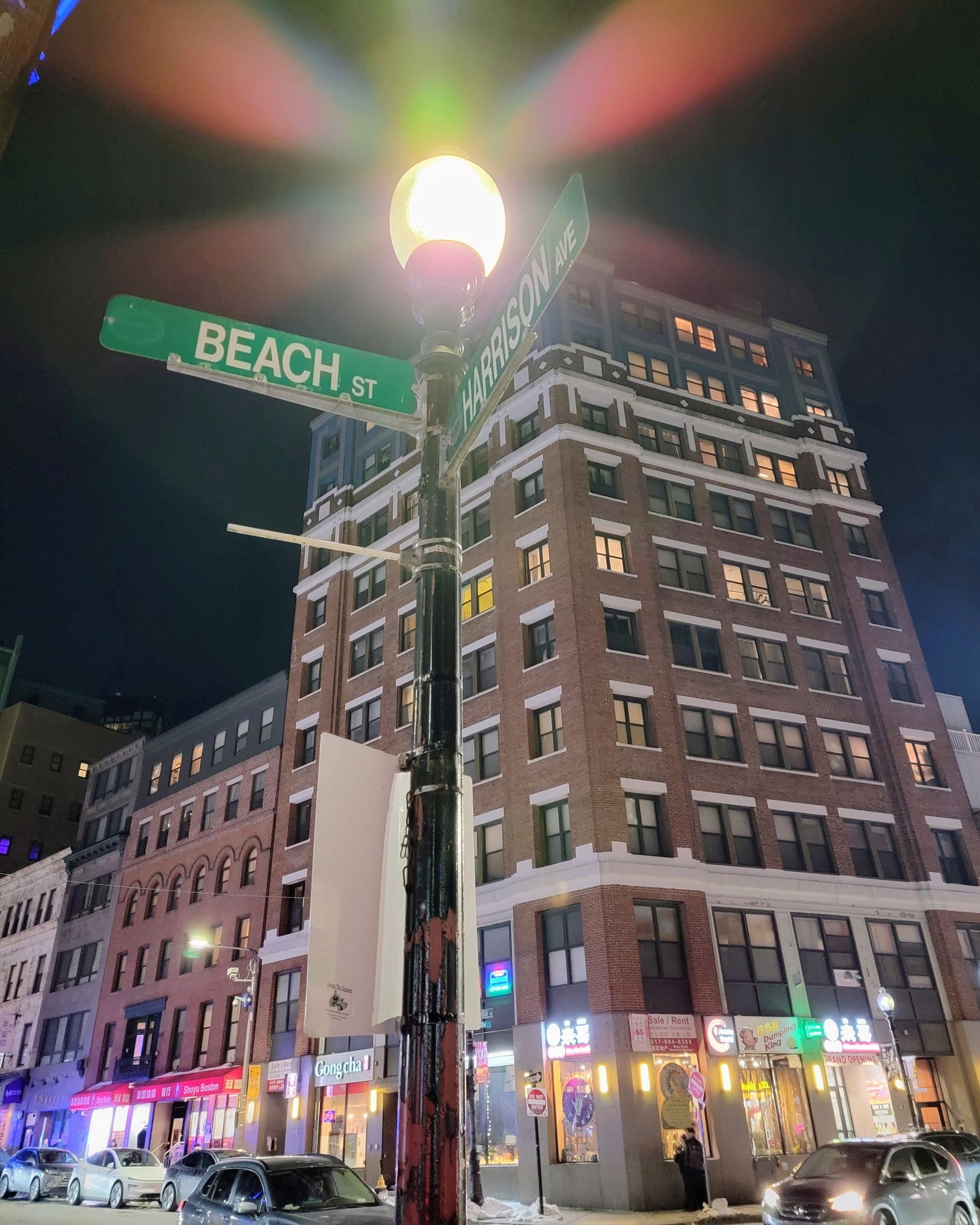
Site of the last-standing laundry in Chinatown.
Chinatown’s “Front Stoop”
Turning onto Beach Street made it impossible to miss the brilliant archway of the Chinatown Gate, standing tall above the park and courtyard underneath, its entrance flanked by two large, marblestone lions.
After the Chinese Exclusion Act was repealed in 1943, Chinese citizens were finally allowed to reunite with and bring their families to the U.S. The influx of families, women and children brought growth to Chinatown, and laundries became restaurants. New businesses, groceries, and stores for goods and services were established, all serving the growing Chinese population.
The area under the Chinatown Gate was a public space for community-centered culture: celebrations, holidays (such as Lunar New Year!), political activism, and was even home to a large, community bulletin board for events and job postings. Even in present day, this area, known as “Chinatown’s Front Stoop,” is a bustling gathering space for daily life, with metal cafe tables and chairs set up with Chinese Chess, areas for seniors to practice their morning Tai Chi exercises, and a playground for the preschool around the corner.
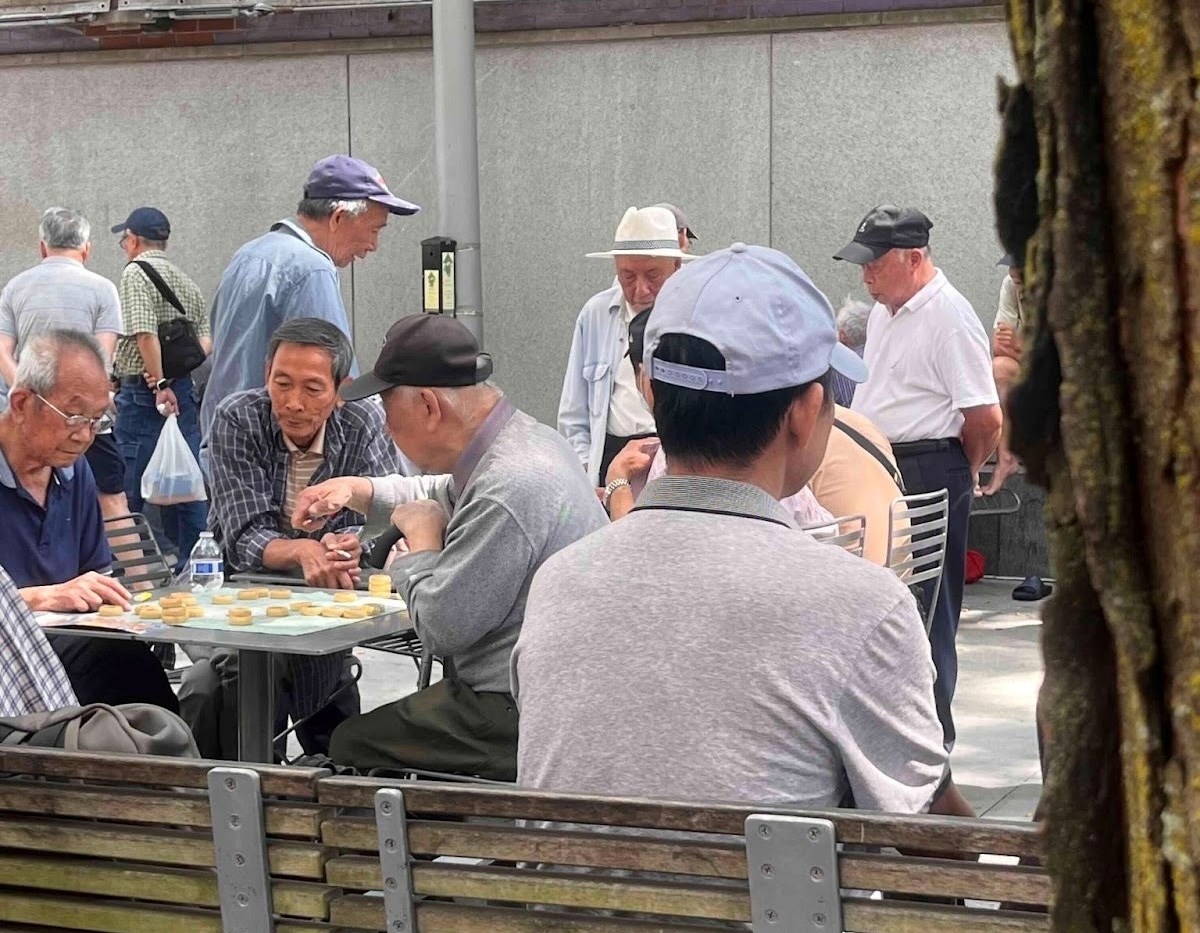
Older adults playing Chinese Chess in Mary Soo Hoo Park in the summer, under the Chinatown Gate.
The Chinatown Gate was gifted to the city of Boston by Taiwan in 1982, and it is also affectionately known as “the Friendship Gate.” It looks out, toward the harbor, and the words inscribed in gold across the top read, “All Under Heaven are Equal,” underscoring the importance of international connection and upholding democracy.
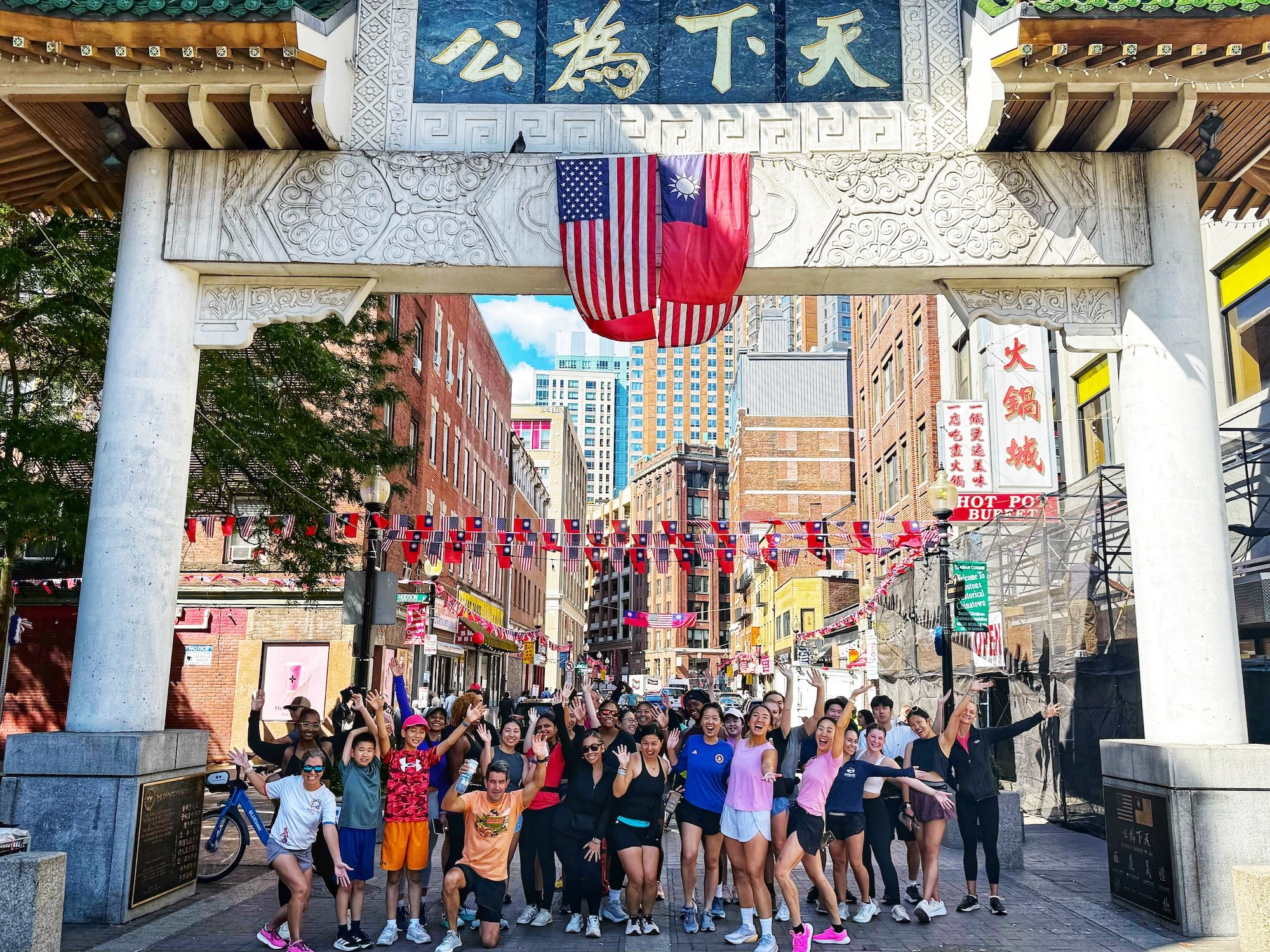
Group photo from a Chinatown food run tour in the summer, in front of the Chinatown Gate.
Celebration as Resistance
The final two stops in the run tour were at two murals erected in Chinatown as part of local efforts to push back against gentrification and displacement. “Where We Belong” features a dragon made of red and golden strands of noodles, stretching around the wall of the former Ho Toy Noodle company, a long-standing staple of the community. It showcases Chinatown’s working class roots and the interconnectedness of Chinese American history with the history of the city of Boston.
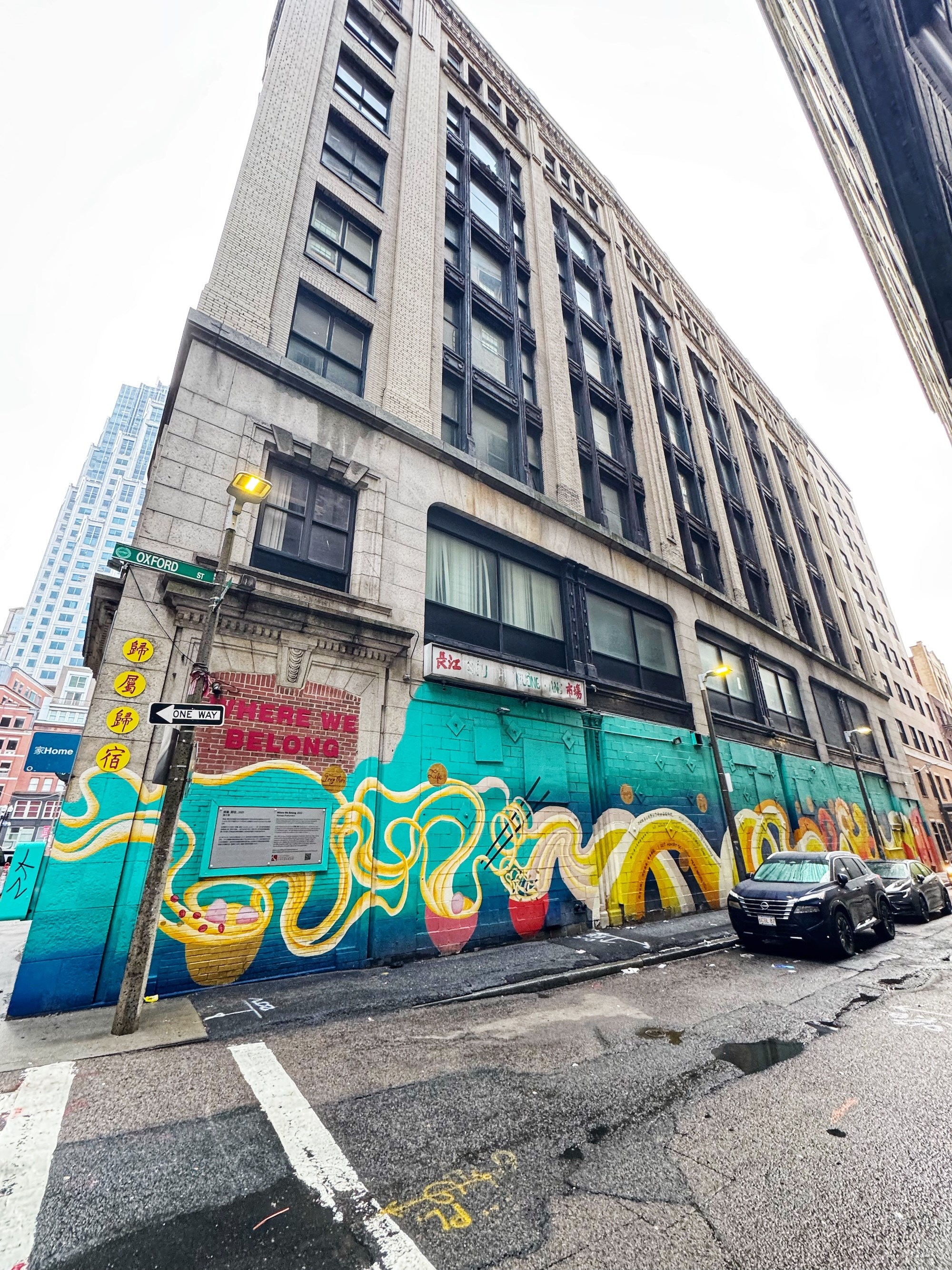
“Where We Belong” mural.
The next block over, “Tied Together By A Thousand Threads” depicts a young boy with an elder, blowing bubbles that tell the Chinese immigrant story: the building of the Transcontinental Railroad, tireless laundry workers, cultural cuisine, and ongoing activism to protect and preserve the neighborhood.
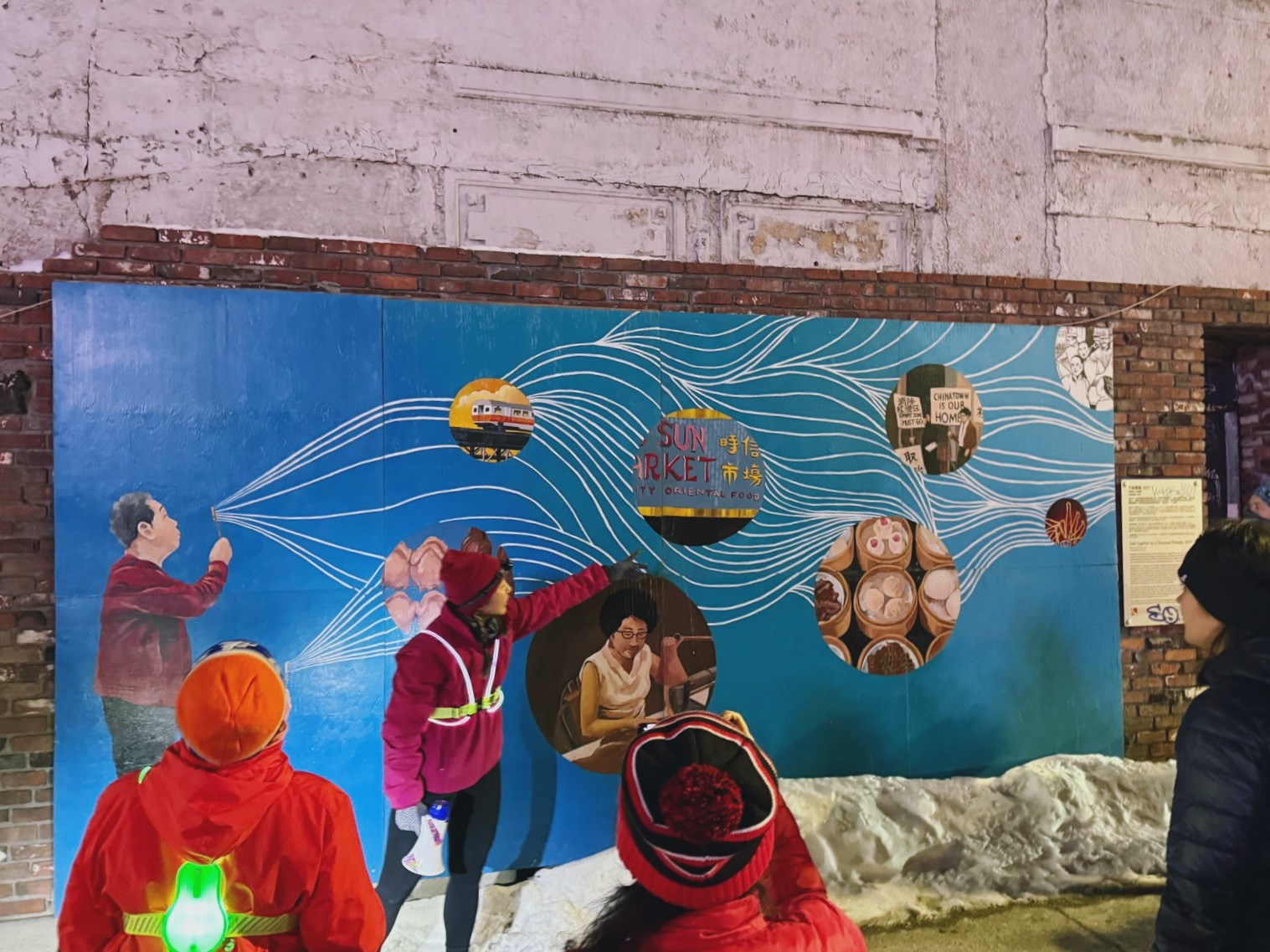
"Tied Together by A Thousand Threads” mural.
As we returned to Newbury Street, hungry and eager to dive into the creamy egg tarts and flaky pastries from Ho Yuen Bakery, I couldn’t help but feel tears welling up inside me. The story of Boston’s Chinatown is the story of so many immigrants across America: it is one of resiliency and of the persistent belief in hope of a greater future; it is one of fighting to be recognized and collectively organizing in order to survive; and it is one of celebration, not simply to preserve and honor our roots, but to declare and remind others that we belong. We are American. And we (and our food!) make America great.
You May Also Like...
The Power of Privilege
Breaking Up with Instagram (and Finding Myself in the Process)