
How to Train in the Heat and Humidity

 This article is by Roberto Mandje, NYRR’s Senior Advisor of Engagement and Training. We’ll continue to bring you advice and tips from Coach Roberto in the months ahead.
Updated June 2025.
Heat and humidity are the hallmarks of summer. If you’re training, you may be looking forward to cooler days and improved fitness.
In the meantime, there are several tips and tricks I’ll happily share with you to help you get the most out of your summer training, pivot when needed, and set yourself up for a great fall season of running and racing.
Before we get started, remember two things. One, when it comes to heat and humidity, everyone runs differently (pun intended)—that is, we are all affected differently by sultry conditions, so train by effort, not pace. Two, safety is your highest priority, so follow our warm-weather running guidelines.
Best Time of Day to Run
If possible, I recommend doing your runs early in the morning or later in the evening, so you’ll avoid the day’s peak heat and humidity. Aim to run at around sunrise or sunset, which in the summer probably means sometime between 6:00 a.m. and 7:00 a.m. or between 6:30 p.m. and 8:00 p.m.
What to Wear
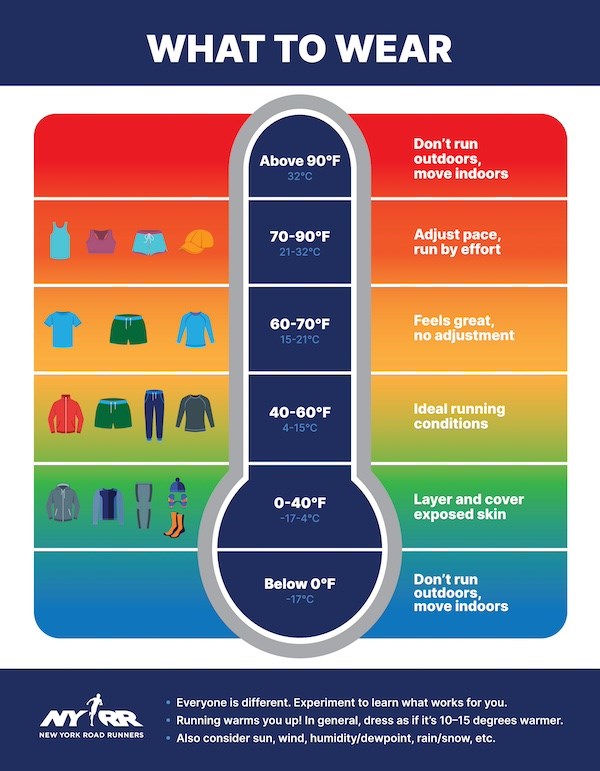
When it comes to running and tech fabrics, I truly feel like we’re living in the golden age. Just about all clothing has some form of moisture-wicking technology. In hot and humid conditions, it’s smart to wear light-colored clothing to absorb the least amount of sunlight, therefore keeping you cooler. Check out the helpful chart above, and read more here about running in all types of weather.
Many brands now make athletic apparel with built-in sun protection (typically UPF 50+). As a parent, I have my active kids running around all summer with UPF tops that help block UVA/UVB rays.
Hydration and Electrolytes

Maintaining your hydration and electrolyte balance will ensure you get the most out of your training and racing. Many people don’t adjust their hydration and electrolytes in the warmer months. Instead, they’ll wait until they feel thirsty—too little, too late on the performance side—or simply hydrate with water.
To match the demands of the conditions on your body, hydrate with electrolyte drinks, which contain salt and minerals such as potassium, phosphate, calcium, and magnesium. Your body secretes electrolytes while sweating, and a deficiency can lead to a decrease in performance, including muscle fatigue and cramping. Electrolytes can be consumed through your diet, and during exercise via sport drinks (either pre-made or tablets mixed with fluids) or with salt tablets chased with water or your drink of choice.
Though we all sweat differently, as a rule of thumb I’d say aim to drink 18–24 ounces of water or electrolyte drink 1–2 hours before your run. During your run, carry a bottle and drink every 20–25 minutes for runs longer than 30–40 minutes. Sticking to a schedule during your runs, especially long runs, will ensure that you don’t go too far or long without hydrating. Post run, aim for another 18–24 ounces of fluids.
Safety in Extreme Heat
If there’s a heat wave, worry not—you have options.
The "wet-bulb temperature" is a reference point and measurement of how well the human body can cool itself through sweat in hot and humid conditions. Wet-bulb readings of 88 degrees F and above are deemed too dangerous, even for healthy young adults. Similarly, a temperature and humidity combo of above 90–95 degrees F with 70%+ humidity is deemed unsafe. Read more here.
If the forecast calls for these conditions, it’s better to play it safe and alter your plans. If you do run outside in these conditions, I suggest you ditch the watch and run on effort, not pace. “Slow” miles are still training miles. Or you can split your run so you’re not in those conditions for too long (see below).
Breaking Up Long Runs

Long runs are the cornerstone of training for marathons and half-marathons, but they may need to be modified during warmer months. Keep in mind that ideal racing conditions tend to feature cooler temperatures (45–60 degrees F) with low humidity.
A long run in the heat can be extra challenging, especially if you’re trying to hit a few miles at goal race pace. This is why once or twice during a summer build-up, it’s okay to break up your long runs.
An example would be splitting a 12-mile long run into a portion outdoors and then the rest on a treadmill (if you have access) including a few race-pace miles to give you optimal conditions for those important miles.
If you don’t have access to a treadmill, you could run the easier portion of the run early in the day and the rest in the evening. This might mean you get out, do an easy 6–8 miles comfortably, and then in the evening head out and do the remaining 4–6 miles at a faster pace.
The key with all these tips is to stay safe and stay positive. Summer running will give you a physiological and psychological boost in the fall. Remember, you’re the sum of your training. Try not to stress if a week or two here and there isn’t ideal.
We can’t control the weather, but we can control our approach, our preparation, and our outlook. Executed correctly, you can still emerge from the summer a fitter version of yourself, and reap the rewards of your training once the cooler months roll in.
Happy running!