
Runner Health and Safety

New York Road Runners races require preparation and planning by both runners and event medical personnel. New York Road Runners works closely with professional medical partners and dedicated volunteers to ensure trained staff are positioned at the start, along the course, and at the finish area. These teams are prepared to respond to the medical needs of runners, spectators, volunteers, and staff throughout the event.
Participate only if you are properly trained and physically prepared to complete your race distance. Consider consulting with your physician prior to race day.
If you are injured or experiencing symptoms such as fever, weakness, diarrhea, or vomiting prior to your race, consider whether you are physically prepared to participate. If you are feeling weak or unwell on race day, do not feel compelled to continue. Listen to your body and the signals it is sending.
Be Prepared: Update Your Emergency Contact Info and Save the RCC Number
- Make sure your emergency contact information is up to date in your NYRR account and on the back of your bib. Learn how to update your emergency contact information here.
- If you have a medical emergency or see another runner with a medical emergency at a New York Road Runners Race (including in the start or finish areas) call the Race Communications Center (RCC) at 866.705.6626. It serves as the emergency hotline and is faster than calling 911 on race day. Save the number on your phone.
- Tell your friends and family to call the Medical Information Hotline number (855.697.7786) to ask about runners who have received medical assistance during the race.
- Runners can opt into NYRR SMS notifications by logging into their runner dashboard.
- Click on “Your Events” and navigate to “View Registration” next to the event.
- Under “Mobile Number” check the box "I want to get event updates via text."
Know Your Resources: Medical Stations
- Review the race course map and familiarize yourself with the locations of medical stations, hydration points, and other on-course support. Every medical station has water, sports drinks, toilets, period products, and medical facilities.
- Review the “Race Day” section on the race page for everything you need to know for a successful race.
Be Ready to Act: Learn Hands-Only CPR
Runners support one another—if you see another runner collapse:
- Call the RCC at 866.705.6626. On race day, this will be faster than calling 911.
-
Push hard and fast in the center of chest to the beat of a
familiar song that has 100 to 120 beats per minute. See the
suggested
list of songs from the American Red Cross.
Don’t drop the beat—ask someone to take turns with you until medical help arrives.
- Watch this video to learn more.
- If you are interested in free CPR courses, visit the NYC Health website to learn more.
Nothing New on Race Day: Race Like You Trained
On race day, stay hydrated and fueled: drink and eat like you trained.
- Follow the simple rule for hydration—"drink to thirst".
- Drink both water and sports drinks to stay hydrated and maintain sodium levels.
- If you did not train with caffeinated gels, bars, or drinks, don’t try one on race day.
- On race day, carry your own fuel:
- Plan ahead and carry the fuel and hydration you need to perform your best. Availability of on-course nutrition and hydration varies by race distance and event. Specific details—including locations and available products—can be found on each race’s webpage.
- Wear shoes and clothing that you trained in.
Know the Signs: Listen to Your Body and Recognize Warning Signs
Listen to your body, and if you experience any of the following or have any other unusual symptoms on race day, stop at a medical tent to get checked out:
- Chest pain, tightness, pressure, or discomfort
- Heart skipping a beat, pounding, or racing
- Dizziness or feeling faint
- Having a hard time catching your breath
- Nausea or vomiting
- Tingling sensations in your extremities
- Stopped sweating
- Stabbing pain
When in doubt, stop at a medical tent to get checked out before continuing with the race.
Stay Alert: Look at the EAS Flags and Adjust to Course Conditions
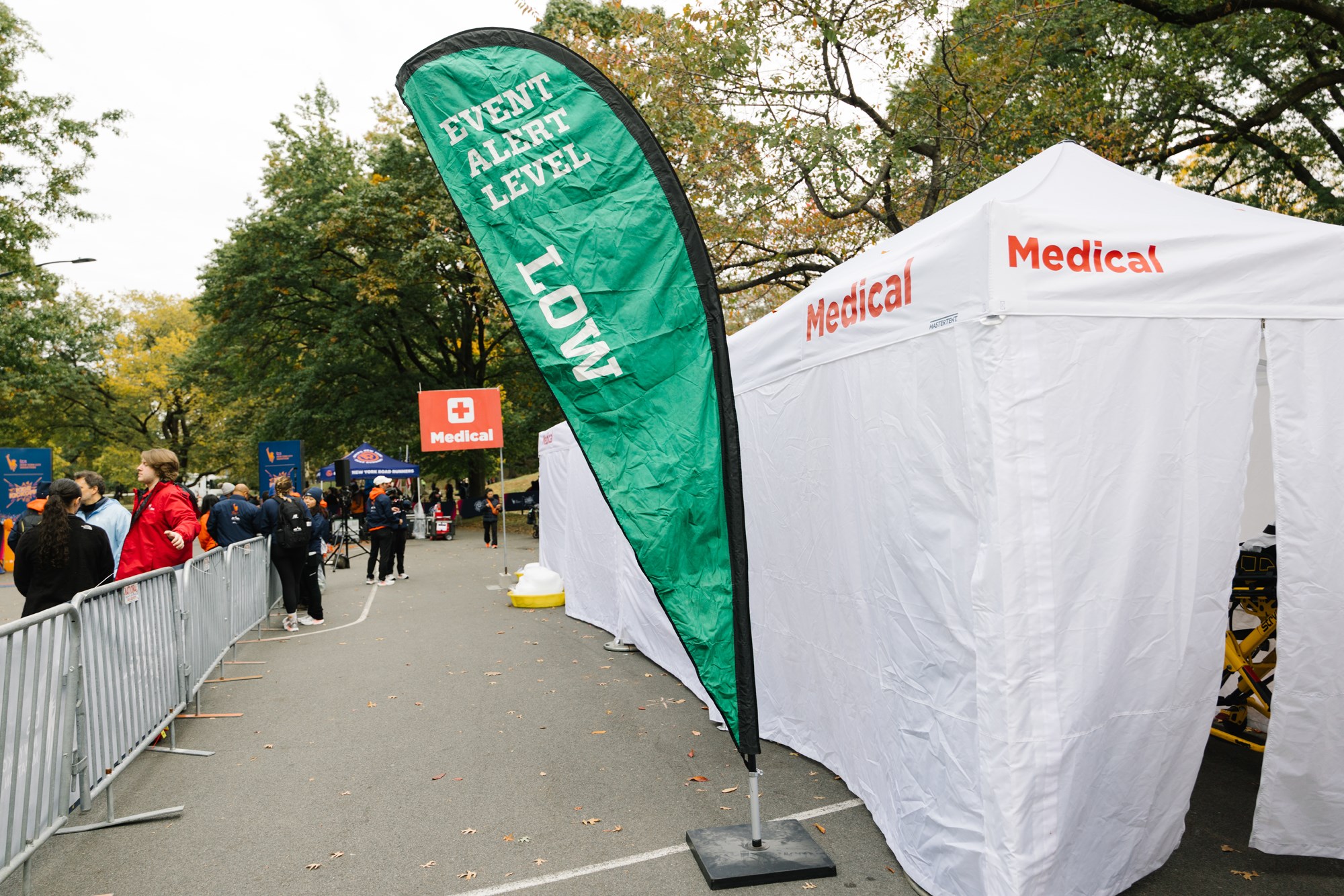
- Familiarize yourself with the color-coded Event Alert System (EAS) that will communicate the status of course conditions. On race day, remain alert and take precautions to prepare properly for varying weather or course conditions.
- EAS flags are at the start, at each medical station, and at the finish.
Scroll to the left on mobile to see full chart.
| Alert Level | Event Conditions | Recommended Actions |
|---|---|---|
| Extreme | Event cancelled / Extreme and dangerous | Participation stopped / Follow event official instruction |
| High | Potentially Dangerous | Slow down / Observe course changes / Follow event official instruction / Consider stopping |
| Moderate | Less Than Ideal | Slow down / Be prepared for worsening conditions |
| Low | Good | Enjoy the event / Be alert |
We wish you a safe and enjoyable race, and remember you could save a life by learning and performing hands-only CPR on and off the course.