
Trailblazers
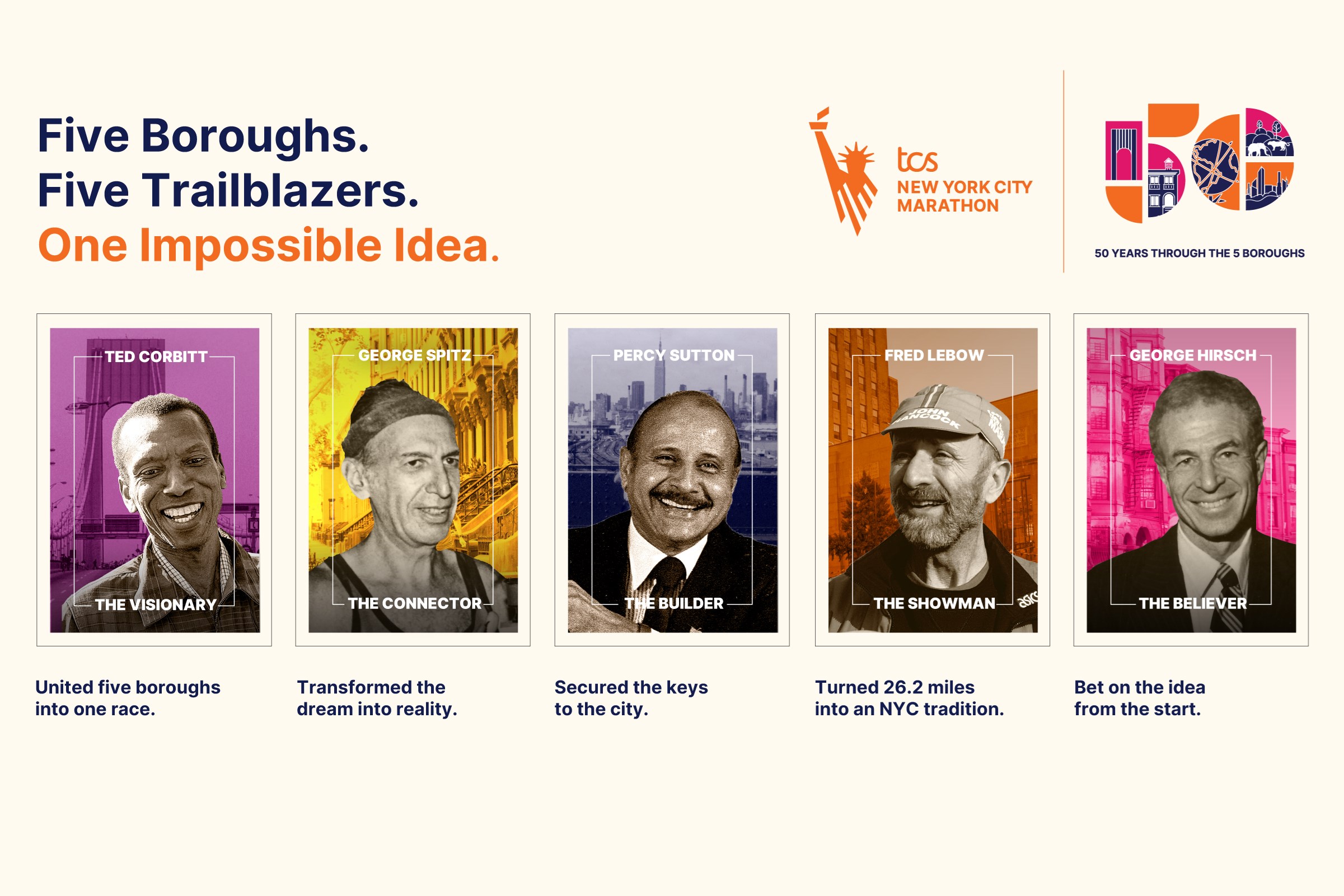
Five Trailblazers. Five Boroughs. One Impossible Idea.
Before the bridges closed. Before millions cheered in the streets of New York City. Before the marathon became the world’s biggest stage for running. There were five trailblazers who believed a race could unite an entire city.
In 1976, their vision transformed the New York City Marathon from a local race confined to Central Park into a 26.2-mile journey through all five boroughs. On October 24, 1976, runners stepped onto the Verrazzano-Narrows Bridge for the first-ever 5-boro marathon, forever changing the sport—and New York City itself.
They were visionaries. Builders. Connectors. Believers. The people who turned an impossible idea into a global tradition, emulated in major cities around the world.
Fifty years later, their legacy lives on in every runner, every volunteer, every bridge crossed, and every New Yorker who lines the streets to cheer.
This is more than the story of a marathon. This is the story of the trailblazers who built it.
Ted Corbitt — The Visionary
As the first president of New York Road Runners from 1958–1960, a pioneer in long-distance running, and the first African American Olympic marathoner, Corbitt imagined a marathon that extended beyond Central Park and connected all five boroughs through the sport. At a time when the concept seemed improbable, he saw the potential for something bigger: a race that belonged to the entire city.
Known for his precision and innovation in course measurement, Corbitt ensured the new course measured an exact 26.2 miles—laying the groundwork for one of the most iconic routes in sports history.
George Spitz — The Connector
A political activist and passionate runner, Spitz played a critical role in connecting the worlds of running and city politics. Spitz embraced Corbitt’s vision and advocated for a special, citywide race worthy of the Big Apple to celebrate the nation’s Bicentennial. He arranged the pivotal first meeting with Manhattan Borough President Percy Sutton—a conversation that sparked the realization of the five-boro course.
Behind the scenes, Spitz helped build the relationships and momentum necessary to move the marathon from a bold idea to a citywide event.
Percy Sutton — The Builder
Percy Sutton turned the vision into reality.
As Manhattan Borough President in 1975 and 1976, Sutton recognized the potential of the marathon to showcase New York City on a global stage. He proposed the now-iconic route beginning on Staten Island and crossing the Verrazzano-Narrows Bridge.
Serving on the Honorary Board of Advisors and as Chairman of the Marathon Committee, Sutton rallied support from Mayor Abe Beame, the other borough presidents, city agencies, and civic leaders, forging the partnership between New York Road Runners and New York City that remains the foundation of the TCS New York City Marathon we know today. He also secured the initial $25,000 contribution from the Rudin family that helped bring the race to life.
Without Sutton’s leadership and political influence, the 5-boro marathon may never have left the drawing board.
Fred Lebow — The Showman
Fred Lebow understood that the marathon could become more than a race—it could become a spectacle.
As president of New York Road Runners and race director of the New York City Marathon in 1976, during the inaugural 5-boro race, Lebow brought unmatched energy, creativity, and promotional instinct to the event. He envisioned the race as a celebration of New York City itself and worked tirelessly to generate excitement around it.
Lebow also recognized the importance of attracting elite athletes like Bill Rodgers and Frank Shorter and notable participants like New York City Ballet dancer Jacques d’Amboise and Newark Mayor Kenneth A. Gibson, elevating the New York City Marathon’s profile and credibility on the world stage.
His larger-than-life personality helped shape the spirit and soul of the event that continues today.
George Hirsch — The Believer
Every great idea needs someone willing to bet on it. George Hirsch did exactly that.
Hirsch participated in the marathon’s earliest planning meetings and personally contributed $5,000 to finance the race. He also quietly paid star runners Bill Rodgers and Frank Shorter for participating, recognizing the importance of creating excitement around the inaugural event.
Leveraging his media connections as founder and publisher of New Times, Hirsch helped organize the Tavern on the Green press conference on Sept. 16, 1976, that introduced the New York City Marathon to the world.
He believed the marathon could become something historic before anyone else did.